Crane’s Reactor: Who Builds It, Why It’s There, and Who Isn’t Sold
 Mr.Newz
Contributor
Mr.Newz
Contributor
The Pentagon picked Crane. That is the news. Almost everything else is still a schedule.
On September 9 the Department of War said Naval Weapons Station Crane will host the Navy’s first shore-based advanced micro modular reactor, and Indiana’s first power-producing nuclear plant, no later than September 2028. The unit is to be commercially owned and operated. It is supposed to run around the clock off the civilian grid so the base can keep working if the wires go down, get hacked, or get hit.
A vendor has not been named. A design has not been named. A price has not been named. Michael Dodd, assistant secretary of defense for critical technologies, told reporters the site was chosen because the clock is louder than the brochure. President Trump’s 2025 executive orders set a hard date: an Army-regulated reactor operating on a domestic military installation by September 30, 2028. “Time had priority for us,” Dodd said. Crane was the place they thought they could still hit that date.
Who Is Designing and Installing It
Do not confuse Crane’s reactor with the five Janus awards announced two weeks earlier.
The Army’s Janus Program is the Pentagon’s lead office for installation nuclear power. In late August it named five companies and five Army posts, with up to $2.2 billion on the table through 2031:
- Antares Nuclear — Fort Bragg, N.C.
- BWXT Advanced Technologies — Fort Campbell, Ky.
- General Atomics Electromagnetic Systems — Fort Hood, Texas
- Radiant Industries — Fort Benning, Ga.
- Westinghouse Government Services — Fort Drum, N.Y.
- Army / Janus — executive agent for nuclear energy on military installations; will regulate the unit.
- Navy — owns the mission at Crane; Office of the Assistant Secretary of the Navy for Energy, Installations and Environment (Brendan Rogers).
- Defense Innovation Unit — commercial-tech matchmaker.
- Office of the Assistant Secretary of War for Critical Technologies — coordination.
- State of Indiana — listed as a joint partner.
Those firms are supposed to own, build, and operate microreactors. The Army has said it expects more than 20 units across Defense installations if private money shows up with the federal pot. Radiant has already disclosed it could take as much as $750 million for Kaleidos units.
Crane is a separate announcement. Officials have not released the Commercial Solutions Opening for the Navy site and have not begun source selection. Nuclear Engineering International put it plainly: eight advanced-nuclear companies remain qualified to compete for military microreactor work; the Crane vendor is expected to be chosen as safety, environmental, and regulatory reviews grind toward 2028.
Who is on the paper now:
Why Install It at All
The official case is energy as a warfighting tool, not a climate speech.
Crane is one of the largest naval installations on earth and a hub for electronic warfare, strategic systems, and expeditionary work. Its daytime population is larger than most of the towns around it. Those labs, magazines, and test ranges currently sit on the same commercial grid as everyone else, with diesel as the usual backup. The Pentagon’s line is that the civilian grid is a vulnerability — physical, cyber, weather — and that liquid fuel is a logistics problem in a real fight.
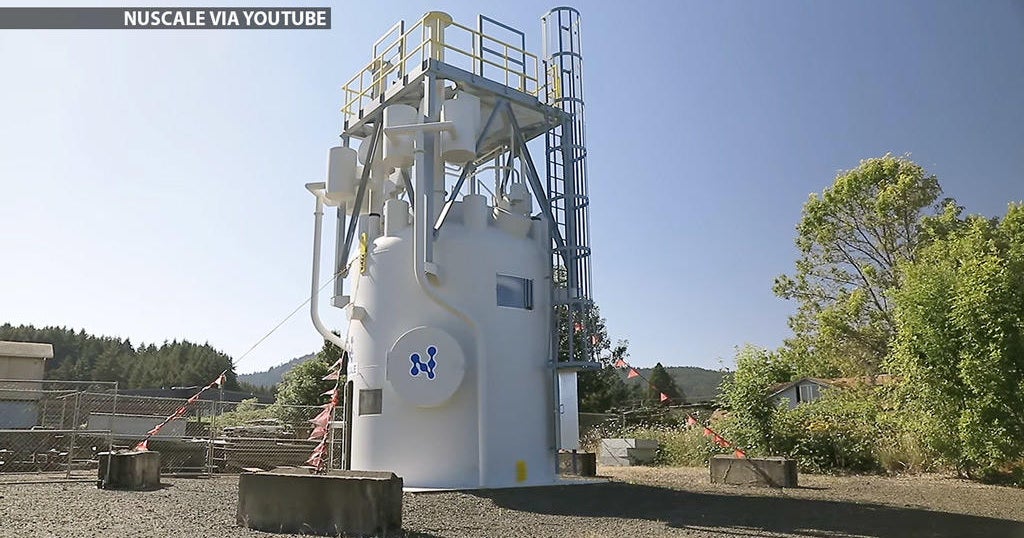
A micro modular reactor in this class is generally factory-built, truckable or air-liftable in concept, and rated at something like 20 megawatts or less. That is not a city plant. It is a base plant. The point is islanded power: Crane keeps the lights on for the work that cannot wait for Duke Energy or a tanker truck.
Nationally, the project is meant to do three other things at once:
1. Meet the 2028 executive-order deadline so the first military MMR is real, not a slide deck.
2. Give American vendors a first customer that is not a utility commission.
3. Rebuild a domestic nuclear supply chain — fuel, components, operators — that atrophied while the country bought expertise and uranium abroad.
Jeff Waksman, the Army’s principal deputy for installations, energy and environment, has said Janus only counts as success if the companies can later sell the same machines to someone besides the Pentagon. That is the industrial-base argument in one sentence.
What Lawrence County Actually Gets
Crane sits in Martin County. The paychecks sit here. Nearly a thousand federal employees already live in Lawrence County. Contractors fill EastGate and the roads to Bedford. A reactor construction window, then a small permanent operations crew, is more Crane-adjacent work — not a downtown renaissance and not a rate cut on your house meter.
The Pentagon release claims the project “modernizes the energy infrastructure needed to serve local communities.” Read that carefully. The reactor is sized and sited for the base. Civilian benefit is second-order: a few construction years, a few specialized jobs, a slightly less strained regional grid if Crane stops drawing 10–20 MW from the same wires, and a political claim that Indiana is in the nuclear business. It is not a replacement for the hospital, the ambulance problem, or Main Street.
Who Objects, and Why
There is not yet a named “Stop Crane Reactor” committee in Williams or Loogootee. The announcement is five days old. What exists is a standing Hoosier skepticism toward new nuclear, and it will find this project.
Citizens Action Coalition, led by Kerwin Olson, has spent the last two sessions arguing that small modular reactors are not cost-competitive, not commercially ready, and a poor answer to load growth. After First American Nuclear’s Indiana announcement, Olson said SMRs are “years away from being commercially available, if they ever will be.” That critique travels easily to Crane: first-of-a-kind, no public price, commercially owned on a federal reservation.
Hoosier Environmental Council opposed the state bills that paved the way for SMRs. Their objection is less “meltdown in the hills” than “ratepayers will eat an expensive experiment while wind and solar are cheaper and faster.” Crane’s unit is supposed to be paid as a defense project, not an IURC rate case — but the precedent still matters if the next reactor is sold to a utility.
State process. A 2026 nuclear bill fight in Indianapolis turned on whether IDEM would keep the power to call a public hearing on siting. Sen. Andrea Hunley (D-Indianapolis) said stripping state process “looks like we are taking some of those [safety] away.” Olson said his group does not accept that radiological safety is only Washington’s business in practice. Crane will run through federal safety, environmental, and Army regulatory reviews. Local people who want a county-level veto will not get one.
Comment-section Indiana, which is not an organization but is a constituency, is already asking the two questions that will follow every public meeting: Is this an unproven machine being rushed to hit a presidential date? And does any of the power leave the fence?
Those are fair questions. Officials have not published a design, a vendor, a waste plan for this specific unit, or an evacuation-and-notification package for the towns that sit downwind and down-road. They have published a deadline.
The Long Game
If Janus works, Crane is a prototype customer for a product the military wants at dozens of posts and that vendors want to sell to data centers, remote industry, and allied bases. That is the national benefit as Washington describes it: resilient power, a rebuilt nuclear shop floor, and a first concrete example instead of another study.
If Janus slips, Crane becomes the place that absorbed the schedule risk — the installation chosen because it could be ready on paper by 2028, not because it had the most elegant mission-to-megawatt match. Dodd said they were not first picking an AI hall or a directed-energy range and then finding a reactor. They were picking a clock.
Lawrence County’s interest is narrower and older. Crane already underwrites a quiet middle class from Bedford to Loogootee. A reactor that stays on schedule, stays inside the fence, and does not scare off the next contractor is a win for that arrangement. A reactor that becomes a national argument about waste, cost, and rushed first-of-a-kind machines will be felt here whether the megawatts ever leave the base.
Vendor, design, and price still to come. Until those three words have names, “Indiana’s first nuclear plant” is a date on a press release and a construction fence that has not gone up.
No thoughts yet — be the first.